


Adblocker detection helps website owners identify advertising opportunities that blocking prevents them from monetizing. It also provides the information needed to choose an appropriate recovery approach and measure what happens afterward.
That role is increasingly important because blocking can affect advertising, analytics, and recovery messages differently. Browser extensions, built-in browser protections, and DNS or network filtering do not create identical technical obstacles.
Detection is the foundation of Admiral’s Full Spectrum Adblock Recovery. It helps publishers understand the blocked audience before applying Full-Stack Recovery, reinsertion, Server Protect, or an alternative value exchange.
Here are three reasons detection matters, followed by how publishers can put it to work.
Revenue Protection
Advertising supports the content, staff, and services publishers provide. When an ad request is blocked, the affected opportunity cannot generate revenue through the publisher’s normal advertising stack.
Detection makes that audience visible to a recovery program. Publishers can then invite visitors to allowlist the site, apply an appropriate reinsertion method, or offer another way to support the content.
Full-Stack Recovery restores the publisher’s advertising stack when visitors allow ads. Reinsertion provides another advertising path: Acceptable Ads reaches eligible participating blockers, while Proxy reinsertion can recover ads in some other blocking environments.
Where advertising is not the right outcome, a paid subscription, donation, or another exchange may create value. Detection itself does not restore an ad or convert a visitor. It supplies the signal that lets publishers decide what to do next.
This also helps publishers avoid applying the same response to everyone. A visitor who can change an extension’s settings has a different opportunity from someone behind network filtering they do not control.
User Experience Optimization
Blocking can affect more than advertising. Depending on the configuration, it can suppress scripts or page elements used for analytics, recovery messages, and other publisher engagements.
See 10 Ways Adblockers Can Impact Websites for examples.
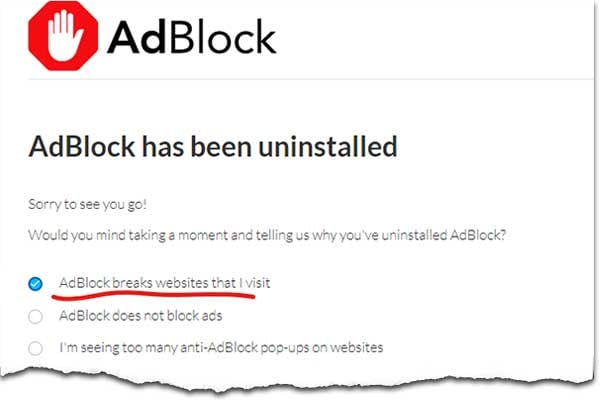
Detection helps publishers identify affected visitors and give them relevant guidance. Explain how advertising supports the content and provide clear instructions for allowing ads on the site. If visitors prefer another exchange, make that option understandable and accurately describe its benefits.
The advertising experience still matters. The Coalition for Better Ads’ Better Ads Standards identify advertising experiences associated with low consumer acceptability. Publishers should review the experience visitors will receive rather than rely only on a persuasive recovery message.
A visitor who never sees the message has not necessarily refused the request. Brutal blockers may prevent an engagement from appearing. That is a technical delivery issue requiring investigation, separate from copy, timing, or offer optimization.
Data Analysis and User Insights
Detection supports a more useful view of the audience than a single sitewide adblock percentage. Combined with Adblock Analytics, it helps publishers assess blocked visitors, pageviews, impressions, estimated revenue losses, and recovery performance.
Visitor-based and pageview-based rates answer different questions. If blocked visitors read a different number of pages from other visitors, those rates can differ. Publishers should examine their own reporting instead of assume a fixed relationship between the two.
Audience dimensions such as device, browser, operating system, and geography can help teams identify where recovery experiences need adjustment. Journey reporting then shows engagement views, conversions, and conversion rates, so publishers can evaluate what visitors actually do.
Measurement coverage matters too. If the analytics request is itself blocked, the report can miss activity. These blind spots are part of the dark traffic discussion, but they do not identify one particular blocker or establish that recovery is impossible.

How to Detect Users That are Using Adblockers
Browser-side detection can test whether expected advertising resources or elements load. Their absence can indicate blocking, but an implementation must also account for failures unrelated to adblockers. Publishers need to test detection rather than treat every missing resource as conclusive evidence.
For a technical overview, see How to Detect Adblock on Ad Supported Websites.
Add Layers for More Resistant Blocking Environment
Admiral combines standard client-side detection with additional detection and protection capabilities:
- Advanced Client Protect adds techniques for blockers that interfere with standard scripts and engagements.
- Adaptive techniques and targeted failsafes provide additional detection paths when expected resources are prevented from loading.
- Proxy Protect routes Admiral calls through the publisher’s own domain.
- Server Protect adds server-side checkpoints when browser-side resources or engagements are suppressed.
In a configured Protect Journey, failed loading of the required tag or engagement can trigger content-access protection and guidance to allow ads. That protection layer helps deliver the publisher’s engagement; it should not be confused with automatic restoration of the advertising stack.
Proxy Protect is likewise distinct from Proxy reinsertion. The first protects the path for Admiral calls; the second is a method for recovering advertising opportunities.
Plan for Ongoing Maintenance
Detection needs to keep working as blocking configurations and site implementations change. Publishers maintaining a custom detector must own testing, updates, reporting, and the recovery experience connected to it.
The Admiral versus In-House DIY comparison explains the broader build-versus-buy decision. A detector is one component of a recovery program, not the entire program.

Turn Detection into an Optimized Recovery Journey
Once visitors can be identified and reached, publishers can decide which experience to present. Admiral provides controls for targeting, creative, message timing, frequency, offers, and Journey sequencing.
Interaction Targeting helps publishers time engagements using visitor behavior. AI-assisted message variants and automated testing help improve the message itself.
These are optimization capabilities, separate from detecting blocking. Keep that distinction when assessing performance: was the visitor identified, was the engagement displayed, and did the visitor convert? Different failures require different changes.
The Visitor Relationship Management platform connects these experiences with other value exchanges, including registration, email capture, and subscriptions.
Get Started with Adblock Detection
Admiral’s core platform starts with a single tag, allowing publishers to establish an adblock measurement baseline and configure recovery engagements with minimal development work. Sites requiring server-side protection have additional implementation options, including WordPress, API, and Node.js.
The official Admiral WordPress plugin listing and Admiral’s knowledge library provide implementation resources. The Customer Love team helps publishers launch, interpret results, support visitors, and refine recovery over time.
Use the Ultimate Adblock Revenue Recovery Guide to plan the next steps. For an initial opportunity estimate, try the Adblock Revenue Recovery Calculator, then request a demo.